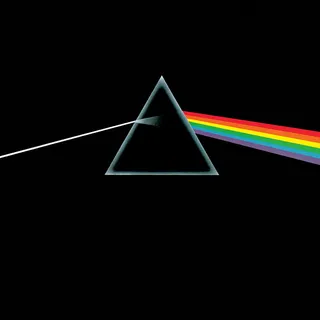
The first sound on The Dark Side of the Moon isn’t music, it’s a pulse. “Speak to Me” is a minute of heartbeat and gathering noise, technically the opener but really a fuse. “Breathe” is what it lights: one long exhale of a chord, E minor to A, drifting back and forth like a tide that can’t decide.
Here’s the thing about that drift. Most rock songs in 1973 wanted to go somewhere. “Breathe” refuses. The two chords swing back and forth and never quite resolve. The song doesn’t progress, it breathes. The title isn’t a metaphor; it’s an instruction. And keep an ear on Richard Wright, the band’s quiet jazz head, when the verse turns around.
Over the top, David Gilmour plays slide in long silver lines that bend like light underwater. And Roger Waters, writing every lyric on the album for the first time, keeps it almost embarrassingly simple. He’d been thinking about how people spend their whole lives rehearsing for a life that never starts, something he has said he only understood at twenty-nine, so he wrote down the advice he wished someone had given him sooner: stay. Notice. Care. He says it plainly, the way you would say it to a friend.
“Run, rabbit, run”
Roger Waters
Then the trap springs. A line arrives that sounds like a playground chant, and the lullaby turns out to be about work: the job, the career, the mortgage, and when one is done, you start on the next. The verse closes by pointing all that effort at where it ends. It’s the whole album in miniature: time, money, madness, death, delivered in a voice so gentle you almost miss it.
And it doesn’t really end. Three songs later, after the alarm clocks have done their worst, the song comes back as a reprise, this time as a homecoming: a tired man at rest for one evening, already knowing the next day will call him out again.
The first song you hear, and the first one that stays with you. Put it on. Lie down. Breathe.
Pearls
0 of 4 surfaced
Surface any pearl, in any order, to hear what's really going on.
I
“Breathe was written for The Dark Side of the Moon.”
tap to surface
I
Roger Waters had already written it. In 1970 he made Music from The Body with avant-garde composer Ron Geesin, a soundtrack about human biology, and it opens with a fragile little song called "Breathe." Waters took the title and the idea, breathing as the barest proof you're alive, and three years later the band rebuilt that obscure leftover into the opening statement of one of the biggest albums ever made.
tap to re-read
II
“That floating slide guitar is a humble lap steel.”
tap to surface
II
On the record, it's a pedal steel whose pedals barely mattered. As fan gear histories tell it, Gilmour bought a Fender 1000 twin-neck pedal steel in a Seattle pawn shop in October 1970, rarely if ever used its pedals, tuned it to open G, and that Fender is the studio slide on Breathe. He made a Nashville machine sound like weather instead of country. The lap steel people picture belongs to the stage: a Jedson, used live on the 1974-75 tours. The humble instrument went on the road; the record got the big one.
tap to re-read
III
“The rabbit line in Breathe comes out of a nursery rhyme.”
tap to surface
III
It comes out of a war song. The words behind that line echo a chirpy 1939 British music-hall hit, a morale song from the first months of the war. Waters, who lost his father in that war, takes a phrase his parents' generation whistled at catastrophe and hangs it on a verse about the grind of modern life. That brightness is borrowed from people trying not to be afraid, and he uses it to describe a life too busy to notice itself. The cheerfulness is the trap.
tap to re-read
IV
“Breathe's chords are simple rock chords, start to finish.”
tap to surface
IV
Not all of them. The verses sway between E minor and A and never resolve, which is why the song floats instead of marching. But the turnaround lands on a chord from somewhere else. Richard Wright, who came from jazz, said it was down to a chord he had heard on a Miles Davis album, remembered and worked out at home. It has been identified as the D7 sharp 9 from "All Blues," on Kind of Blue. Play the turnaround again: that chord is on loan from Miles.