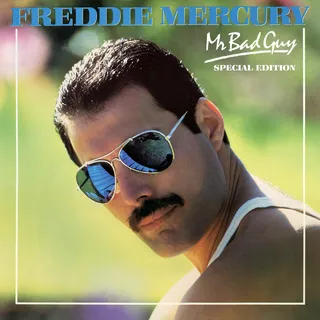
In late 1986 Freddie drove out to a friend’s house outside London, sat down, and cut this in a single November day. A demo, first, before anyone knew where it would go. There’s a lightness in that, a man recording for the love of it, at home, with people he trusted. The seriousness comes later, in what the song is actually about.
Because underneath, this is a man in a tuxedo holding a smile together with both hands. He tells you he’s doing fine. He is, very clearly, not. The whole thing runs on the gap between the face and the wreckage underneath it: the public performance of someone who has lost the person he loved and decided you will never once see it on him. You can hear why it would have caught Freddie’s ear. Nobody on a stage understood that distance better.
And he doesn’t sing it like a confession. He sings it bigger than it needs, theatrical to the point of winking, a frontman who knows exactly how absurd it is to keep grinning while the floor gives way. There’s a joke buried in here somewhere, and Freddie is in on it.
A man holding a smile together with both hands, long after the reason for it left.
Then there’s the single itself, where it went and how far. The number it did in Britain is the part that surprises people once they go looking, because it doesn’t line up with the assumption that his solo years were the quiet ones between Queen records. They weren’t. Not here.
And the video. He made one, with the same director Queen used, and it is the least solemn thing imaginable. No spotlight, no straight-to-camera ballad. He does something stranger, reaching back into his own past with a knowing grin and a rack of costume changes, pulling friends in alongside him. Watch who turns up. Watch how they’re dressed. The man who spent his life building a persona spends three minutes here taking it apart and laughing.
So you have a song about hiding your real face, sung by the most famous mask in rock, staged as a parody of himself. The lyric is about pretending. The whole production is about pretending you’re pretending. Press play, watch him hold the smile, then come back and surface what he was hiding.
Pearls
0 of 3 surfaced
Surface any pearl, in any order, to hear what's really going on.
I
“Freddie Mercury wrote "The Great Pretender."”
tap to surface
I
He didn't. It was written in 1955 by Buck Ram, the manager of a doo-wop group called The Platters, who took it to No. 1 in early 1956. Mercury was nine years old when the song that became one of his best-known solo hits already topped the American chart. His 1987 version is a cover, three decades late to a song that was never his.
tap to re-read
II
“Freddie Mercury's biggest solo hit was one of his own songs.”
tap to surface
II
It wasn't. While he was alive, the highest any of his solo singles climbed in Britain wasn't a song he wrote; it was "The Great Pretender," his cover of a 1955 Platters hit, which reached No. 4 in 1987. Every original he released on his own charted lower. The man who wrote "Bohemian Rhapsody" had his solo peak, in his own lifetime, with someone else's song.
tap to re-read
III
“The video shows Freddie Mercury playing dress-up for a laugh.”
tap to surface
III
Look closer at the two women singing backup. One of them is Roger Taylor, the drummer of Queen, in drag. Both backing singers are men in costume, Taylor and the actor Peter Straker, planted in the frame as Mercury's female chorus. The most theatrical man in rock built his own backing singers out of his bandmate and his friend. The joke isn't the dress; it's who's wearing it.